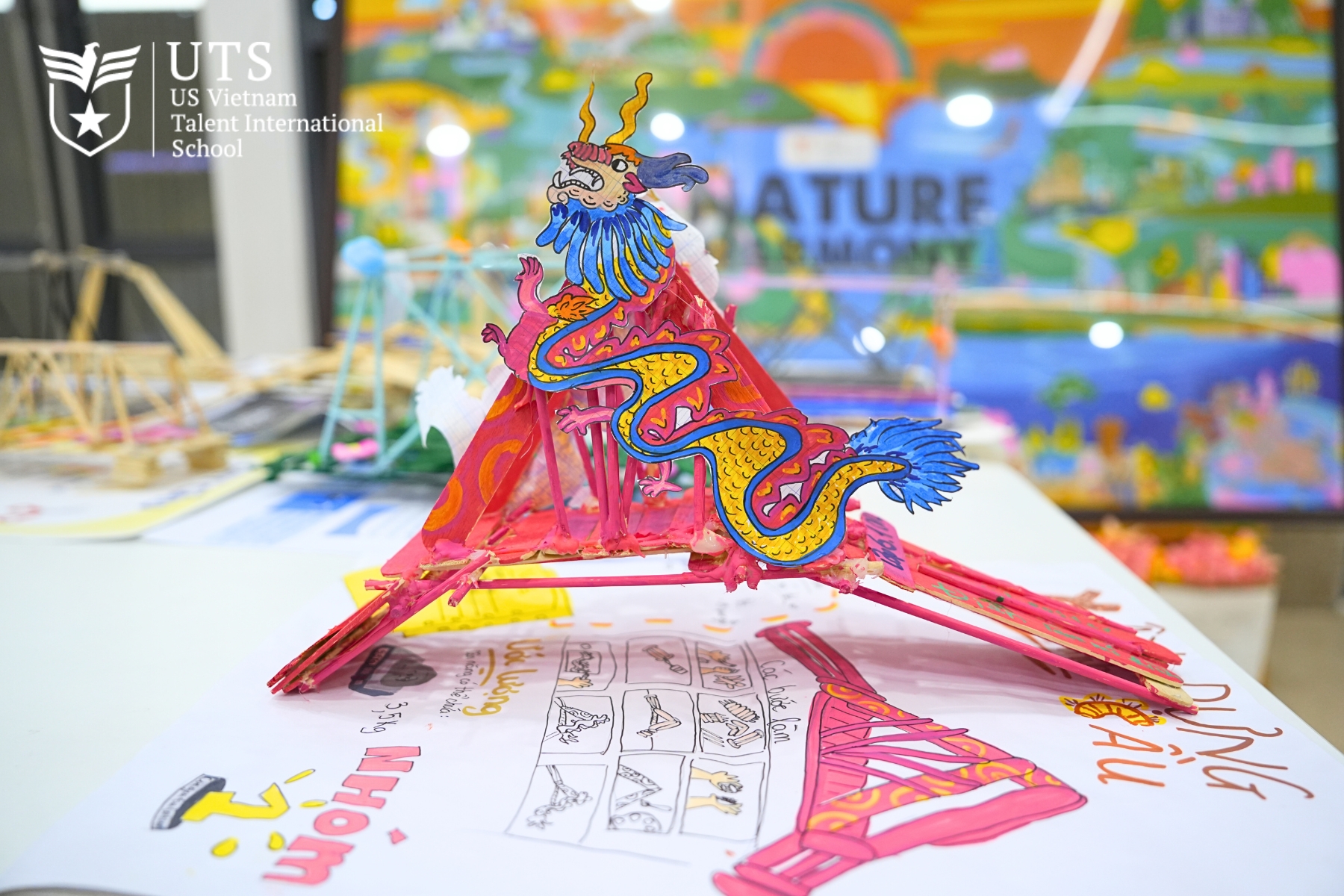
“Hands-on” methodology – Excite creativity and help children enjoy learning

In recent years, the education sector in general and schools have made great efforts to reform the quality of teaching and learning in the natural sciences. With the teaching philosophy of putting Students at the Center”, the US Vietnam Talent International School has applied the method “Hands-on” at the high school level to help students be independent, creative, take initativesinitiatives and solve problems. Besides, this method also helps teachers improve the quality of teaching.
“Hands-on” methodology is the way the teacher organizes for students to self-study to find solutions to the knowledge in the curriculum through proposing, discussing, and performing experiments.
The steps to organizing classes according to this method include:
Stage 1: The starting situation and the question raises the issue.
Teachers will proactively set a starting or questionable situation as a starting point to the lesson. The foreboding circumstances are brief, close to students and practice making questions raises the issue at the same time.
Problem question which is the big question of the lesson itself (or module of knowledges that students will be taught) need to ensure suitable to students’ level, arouse curiosity and researching interest of the students to equip them with studious psych sphere before perceiving sciolism.
Teachers should use open questions instead of closed ones (Yes-No question) in terms of problem questions. It also must meet all the requirements that were mentioned before, so that the teaching scheme of the teachers will be more successful.
Stage 2: Expressing the beginning opinions of students
In this stage, teachers will encourage the students to express thoughts and raise their awareness before learning new things. To raise the starting conception from the students, teachers can request their students to remind the previous lessons that alike with knowledge of the current lesson. When requesting students to express the started awareness, students can be required using various expression forms such as verbal (through personal states), by writing or drawing to express thoughts.
From all the started original opinions from the students, teachers must be skillful in helping students to ask questions. Furthermore, teachers must focus on the conception interdepended with the lesson content.
Stage 3: Offering questions or hypothesis and design experimental plans
From the proposed previous questions, teachers ask some questions, students are propounded to express their hypothesis and design experimental plans, full-searching plans to verify all their theories and find the answers. The full-searching plans that mentioned before are options to find out the answers, such as introspecting, doing experiments
Depending on the knowledge or problem posed, students can propose different research-experiment options. In the process of proposing the experimental plan, if the student’s opinion is correct but the language is not standard or the expression is not clear, the teacher should suggest and help students step-by-step improve the expression. This method encourages students to self-assess each other’s ideas rather than the teacher’s.

Step 4: Carry out research-experimentation
From the experimental research, investigation, and research options raised by students, the teacher skillfully comments on and chooses appropriate experimental equipment or teaching equipment. suitable for students to conduct research. If experiments must be performed, it is preferable to perform experiments directly on real objects. In some cases where it is not possible to conduct experiments on real objects, they can be done on models or for students to observe drawings.
For the observation method, teachers let students observe real objects first, then let them observe scientific drawings or models to enlarge features that cannot be clearly observed on real objects. When conducting an experiment, the teacher clearly states the requirements and purpose of the experiment or asks the students to indicate the purpose of the experiment to be conducted.
Experiments are conducted in turns, corresponding to each knowledge module. After each experiment is done, the teacher should pause for the students to draw conclusions (i.e., find the answers to the corresponding problems). The teacher reminds students to record experimental materials, the layout and implementation of the experiment (describe it in words or draw a diagram), note down the results of the experiment, and the conclusion after the experiment in the actual notebook.
For complex experiments, and if possible, teachers should design a ready-made template for students to fill in with experimental results and experimental materials. When performing individual or group independent practice, it helps students avoid seeing and doing things in each other’s way, being passive in thinking, and it also makes it easier for teachers to detect groups or individuals who excel in performing experiments. Research experiments, especially experiments performed with the same experimental equipment and materials, are generally accepted, but if the experimental arrangement is not reasonable, the desired experimental results will not be obtained.
Step 5: Concluding and validating knowledge
After conducting research-investigation experiments, answers are gradually solved, hypotheses are tested, and knowledge is formed, but it is still unsystematic or not scientifically accurate. The teacher is responsible for summarizing, concluding, and systematizing the material for students to record in their notebooks as knowledge of the lesson. Teachers inculcate knowledge for students by allowing students to look back and compare their original ideas (original conceptions) before learning knowledge.
Thus, from the wrong initial conceptions, after the experimental process of finding and researching, the students themselves discover that they are wrong or right, but not by the teacher’s judgment. Students themselves detect deviations in perception and self-correct and change proactively. These changes will help students remember longer and deepen their knowledge.
The use of the “hands-on” method in teaching natural sciences is a typical method to help students gain skills such as observing, experimenting, explaining phenomena, and applying knowledge in real-life economics. During the experiment, students not only develop observation skills but also develop the ability to conduct experiments. From there, the necessary experience can be drawn so as not to make mistakes in subsequent activities. This method also helps students improve their ability to express themselves, develop scientific language, and gives them the opportunity to form and develop teamwork skills, making the class more united and cohesive. Since then, students have become more interested and enthusiastic about the subject, resulting in higher learning efficiency.
UTS believes that being flexible in applying learning methods will help students have the best opportunity and environment to express and create their own “world,” grow up and maximize their potential. There is potential for personal success and happiness.

UTS Family Sport Day 2026 “Eagles Run, Eagles Go Beyond” officially returns
Khám phá những môn học đặc biệt tại Trường Quốc tế Nam Mỹ UTS và lợi ích vượt trội cho học sinh
Why students should be exposed to STEM education early on?
Vietnam’s Mark – A journey of heart and pride in the nation